Monday, June 23, 2008 by Kyle Scribner
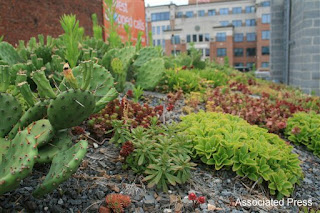 Having a few potted plants spread around the workspace is a time-honored way to lend vibrancy and character to an area that, let’s face it, can be downright drab. The benefits of having greenery around the office are many, including increased job satisfaction, surveys have shown. But with the explosion of the green movement, enthusiasts are going far beyond simply hanging a few spider plants. Rooftop gardens are sprouting on homes and offices around the country, illustrating what can be done with tiny spaces and resources – conditions you often see in the city. You don’t have to take it as far the Dervaes family of Pasadena, Calif., (but if we all did we probably wouldn’t be worrying about salmonella tomatoes or the price of gas), but Green Among Gray would like to see what kind of greenery Captivate viewers have blossoming around the office. Got some cubicle Chrysanthemums or corner-office Crocuses? Show us by submitting photos to kscribner@captivate.com and your pics may wind up on Captivate Network. Labels: green, office plants, rooftop garden, work
  |
» |
»
Tuesday, May 20, 2008 by Kyle Scribner
 So you’ve got a green vibe going at home. You’re paying attention to how many lights you leave on, converting to CFLs and incessantly recycling (you’re the one who stammers, “uh, uh, uh” whenever you catch your kids/husband/wife going to drop scrap paper or a spaghetti sauce jar in the trash, aren’t you? It’s OK. It’s a good thing). How about at work? Is there room for greening there? Probably. At minimum, your workplace should have some sort of recycling program. If not, take the initiative and get it rolling yourself. It can start as simply as commandeering a trash barrel, slapping a recycling symbol on it and placing it in a main hallway. So you can help your work, but your work should also be helping you. One of the easiest ways, as this Forbes.com piece explains, is for a workplace to be commuter-friendly. Firms nowadays are instituting policies such as giving bikes to workers (above), paying for gas, awarding rebates for hybrid purchases and encouraging telecommuting. If your employer isn’t on this list (pdf), there’s probably room for improvement. Also check out the Environmental Defense Fund’s list of companies and the steps they’re taking to go green.
Let us know what “greenery” your workplace is up to.
Labels: commute, commuting, green, workplace recycling
|
»
Thursday, May 1, 2008 by Kyle Scribner
There are a lot of us out here now doing this environmental proselytizing thing. I’ll admit, there’s a bandwagon-y feel to it all (a lot of us green at being green, so to speak). That’s why when you see someone that’s been at it a long time, you must give respect. And today’s Green Among Gray respect goes to The American Institute of Architects, which has been recognizing sound environmental design and building since 1997 with its AIA/COTE Top Ten Green Projects list. The AIA recently named its 2008 honorees, and a few big cities are represented: Seattle, Boston, Kansas City. The buildings are judged on measures that include energy conservation, water use, and bioclimatic design (how well the structure is suited to its surroundings). These buildings make use of such things as rainwater collection (for irrigation) and dual-flush toilets to reduce water consumption; natural ventilation instead of AC; daylighting to reduce electricity draw; recycled materials, such as tires, instead of virgin building materials; and, of course, lots of solar panels. The AIA/COTE list is simply another illustration of how progressive our society can be, how doable all this STUFF that we hear about but don’t really have a context for is. It’s a big-scale thing, for which the responsibility lies not on “average Joe worker” (you and me) but on our employers, on our corporations, on our conglomerates. And the more us little worker bees see of it, the more likely we are to do our small-scale things to pitch in. And, in turn, the more of us who pitch in with little stuff, the more likely the bigwigs will be to enact the big-scale stuff. It can become a self-sustaining process. A green-energy synergy. Let’s keep it rolling. Labels: AIA, American, Architects, buildings, green, Institute, synergy
|
»
Tuesday, April 8, 2008 by Kyle Scribner
Going green seems simple enough: You just set your mind to helping the environment and follow the three-step process of reduce, reuse, recycle, right? But this Los Angeles Times story underscores how difficult it can be to do the right thing, even when you mean well. The 87-year-old billionaire behind online-college behemoth University of Phoenix is pushing an alternative-energy ballot initiative in California that is opposed by seeming comrades-in-arms such as the Environmental Defense Fund and the American Wind Energy Association. Opponents say the act will be counterproductive to long-term progress in developing alternative energies; proponents claim there’s huge public support for it. California has a reputation as being one of the greenest states, so there may be a lot riding on how this plays out. Who’s right? Let us know, Californians and other interested parties. Labels: alternative, California, green, legislation, Los Angeles
|
»
Monday, April 7, 2008 by Kyle Scribner
I imagine some of you are saying, “not another blog about the environment.” Well, yes, technically this is another blog about the environment, but hopefully it’ll be delivering something a bit different. There will be the standard stuff –environmental news and tips – tailored so the big-city worker can easily apply it to his/her life. But Green Among Gray’s main function is to move you to appreciate nature again, to be awed by it like you were as a kid. Why bother, you ask? First, the world appears to be heading for trouble, natural-resource-wise, and one way to stem that is to keep nature top-of-mind; second, we could all use a boost of energy, and a lot of restorative power can come from reconnecting with nature; and, finally, a more shallow reason: ‘Green’ is chic – you’ll have something to add the next time the dinner conversation turns to conservation. Labels: city, environment, gray, green, nature
|
»
|

Kyle Scribner is a born-again nature freak who also happens to be an editor at Captivate Network. You know that exhilarated feeling you got as a kid when you would go down to the pond to catch frogs? It never really goes away; it’s just dormant. So I'm here to slap a mix of facts and borderline balanced opinion on you, to poke a stick at the nature freak slumbering in us all and maybe get him to once again come out and play. And we might even learn a few things about the environment as we go.
About Green Among Gray
How do you commune with nature or become part of the solution to the environmental crisis when you're trapped in a cement-and-glass, gas-guzzling, power-sucking, emissions-spewing metropolis 8 hours (or more) a day? How do you go 'green' in a world of gray?
Actually, there are plenty of ways, and Green Among Gray aims to show high-rise inhabitants how they can help ease the load on the environment and on their minds by exploring natural oases, conservation tips, and other ways to stay green while working in the concrete-built world of the big city.
Look for short updates on the latest environmental news along with periodic longer features on specific places and events that allow big-city workers to get close to nature.
|


